The Indus Civilization by Possehl Gregory L
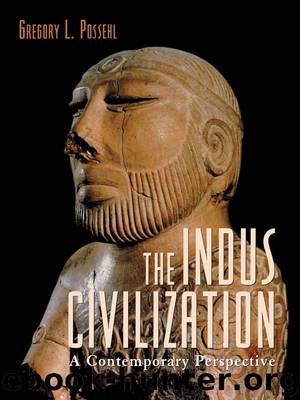
Author:Possehl, Gregory L.
Language: eng
Format: epub
ISBN: 9780759116429
Publisher: AltaMira Press
Published: 2013-06-25T04:00:00+00:00
The Need to Study the Writing System in Its Various Contexts
Fairservis has been the most convincing voice for studying the Indus script within the context of the Indus Civilization. This is intuitively obvious to me, and I tend to neglect its importance when addressing nonarchaeologists, but it is of paramount importance. We must understand the script within the larger context of what we know of the Indus Civilization. This is a matter of theory and of practice. For example, “Fairservis pleads for a reconstruction by the Dravidianists of the obvious artifactual vocabulary familiar to the archaeologist which would include words for characteristically Indus objects (he offers such a word list)—another idea worth attention.”57 In fact, this contextualization of the script is the strongest element in Fairservis’s work with the writing system.58 These skills are not matched by many other workers, Lal and Pande being notable exceptions.
The Indus script was used in diverse cultural contexts from square stamp seals to signs scribbled on potsherds. It is found in the Greater Indus region at great city sites and in small villages on the frontiers of the Indus Civilization, as well as in the Arabian Gulf and Mesopotamia. There are two primary dimensions to this diversity: (1) the kinds of objects that were inscribed, and (2) the geographical contexts of these finds. It seems highly likely that the message on the typical Indus stamp seal with the unicorn and other devices is different from that on the copper tablets, Indus miniatures, and copper tools. If this is the case, then the statistical study of sign position and count should take cognizance of it. The decipherment efforts should not be directed at the script as a general, undifferentiated writing system, but as one delivering messages within the context of different media. The occurrence of Indus writing in the Gulf and Mesopotamia, in contexts whose writing systems are understood, presents special opportunities in terms of deciphering messages.
The kind of work I have suggested has already been tried, but in a very limited set of examples. Pande’s research on the copper tablets addressed a well-defined body of glyptic material. His more speculative paper on the evolution of an individual sign within the script is another example of the sort of intensive, small-scale research that needs to be done.59 Another example is Franke-Vogt’s excellent study of stoneware bangles from Mohenjo-daro.60 These hard-fired objects are often inscribed and might carry one or more of a variety of messages (owner’s identification, maker’s identification, place of manufacture, etc.). The restricted contexts for writing here, and the number of inscribed stoneware bangles, gives promise to research on these objects.
Download
This site does not store any files on its server. We only index and link to content provided by other sites. Please contact the content providers to delete copyright contents if any and email us, we'll remove relevant links or contents immediately.
| Anthropology | Archaeology |
| Philosophy | Politics & Government |
| Social Sciences | Sociology |
| Women's Studies |
Mysteries by Colin Wilson(3455)
People of the Earth: An Introduction to World Prehistory by Dr. Brian Fagan & Nadia Durrani(2738)
Ancient Worlds by Michael Scott(2688)
The Splendid and the Vile by Erik Larson(2474)
Foreign Devils on the Silk Road: The Search for the Lost Treasures of Central Asia by Peter Hopkirk(2464)
The Memory Code by Lynne Kelly(2403)
Come, Tell Me How You Live by Mallowan Agatha Christie(2260)
The Earth Chronicles Handbook by Zecharia Sitchin(2229)
Lost Technologies of Ancient Egypt by Christopher Dunn(2226)
The Plantagenets by Dan Jones(2090)
Last Chance to See by Douglas Adams(1991)
The Return of the Gods by Erich von Daniken(1946)
Wars of the Anunnaki by Chris H. Hardy(1715)
Keeper of Genesis by Graham Hancock(1649)
Before the Dawn by Nicholas Wade(1606)
The Cygnus Mystery by Andrew Collins(1559)
The Message of the Sphinx by Graham Hancock(1513)
Fragile Lives by Stephen Westaby(1455)
A History of the World in 100 Objects by MacGregor Neil(1370)
